



A strong video ad rarely begins on the filming day. It begins with a clear storyboard: a practical map that connects the hook, product benefit, proof, and call to action before the camera starts recording.
Why video ads need a storyboard
Short-form ads move quickly. In fifteen or thirty seconds, the viewer must understand what the product is, why it matters, and what to do next. Filming without a plan often produces beautiful footage that does not form a persuasive message.
A storyboard exposes weak transitions before they become expensive. It shows whether the opening is clear, whether the product appears early enough, and whether the final action feels like a natural conclusion.
Start with the message, not the camera
Before drawing frames, write one sentence for the promise of the ad. For example: “This smartwatch helps busy professionals understand their day at a glance.” Every scene should support that promise.
- Hook: What makes the right viewer stop?
- Problem: What friction does the product remove?
- Demonstration: What must the viewer see to believe the claim?
- Proof: Which detail, result, or comparison builds confidence?
- Action: What should happen after the final frame?
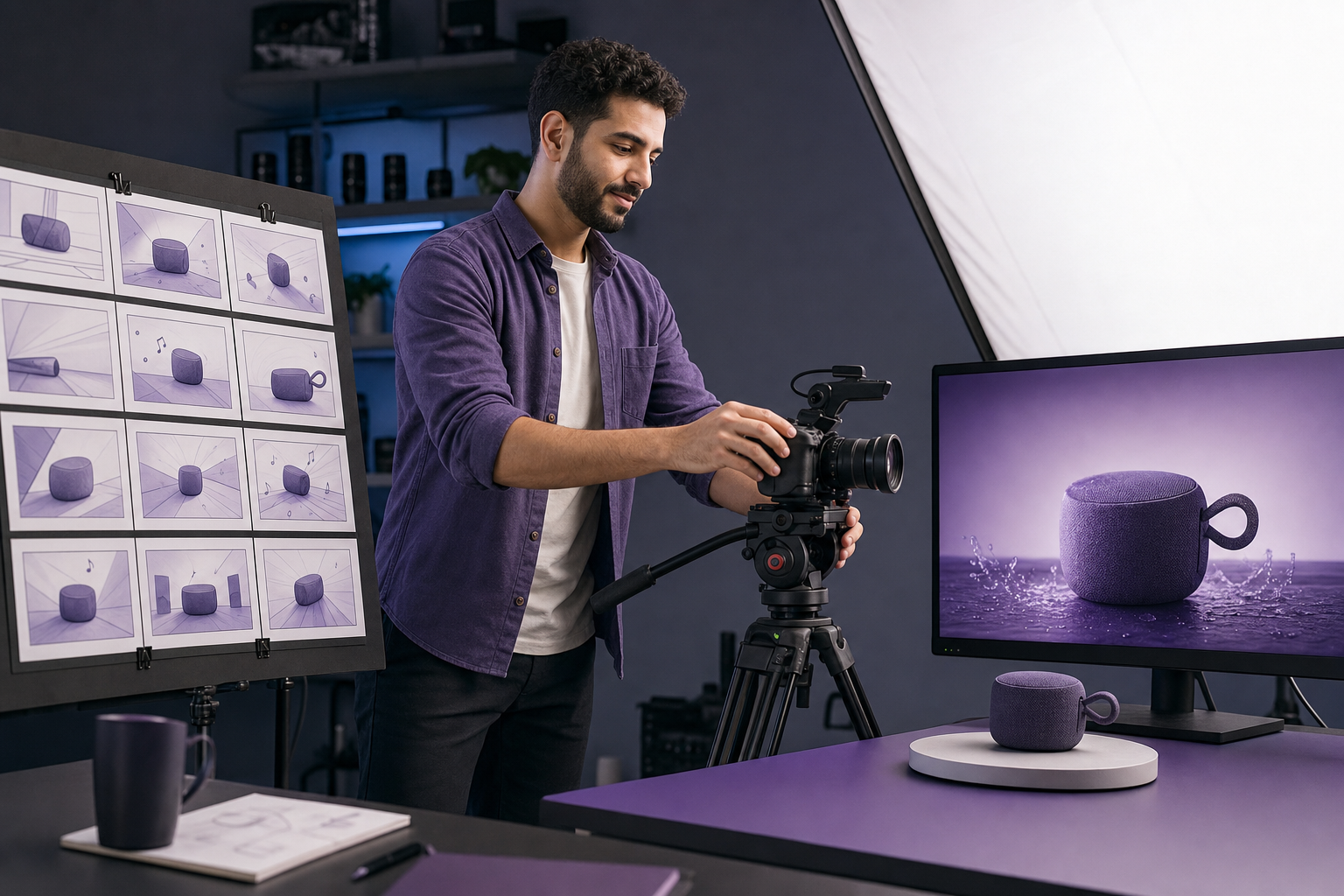
Build the ad in five visual beats
- Pattern break: Use an unusual angle, movement, or product detail to earn attention.
- Context: Show the situation in which the product becomes useful.
- Core benefit: Demonstrate one valuable outcome instead of listing every feature.
- Credibility: Add a result, close-up, comparison, or short customer proof.
- Call to action: End on a clean product frame with one clear next step.
What to write under every frame
A useful storyboard includes more than a sketch. Under each frame, note the shot size, camera movement, action, spoken line or on-screen message, sound cue, and approximate duration. These notes keep the editor, director, and client aligned.
If a frame does not introduce information, create emotion, or move the viewer toward the offer, remove it.
Plan variations before production
Do not storyboard only one opening. Prepare at least three hooks while keeping the middle and ending consistent. This creates useful test variations without multiplying the entire production budget.
You can also plan alternate product close-ups, different proof shots, and shorter endings. A few deliberate options on filming day are far more valuable than hours of random extra footage.
Review the storyboard as a silent ad
Place the frames in order and review them without narration. Can someone understand the problem, product, benefit, and action from the images alone? If not, strengthen the visual logic before adding more words.
The best storyboard is not the most artistic one. It is the one that makes production faster, feedback clearer, and the final video ad more persuasive.