



Video ad length is not a creative afterthought. It determines how much attention you must earn, how much proof you can show, and whether the viewer remembers the brand after the scroll. The right choice between 6, 15, and 30 seconds starts with the job the ad needs to do.
Why video ads became shorter
Mobile feeds created an environment where every second competes with the next swipe. Platforms therefore made short, skippable, and vertical formats central to campaign planning. But “shorter” is not automatically “better.” It simply raises the cost of every unnecessary frame.
Research on mobile advertising suggests that very short ads can reduce resistance, yet shortening the message also makes storytelling, emotional development, and recall more difficult. In other words, brevity can improve the viewing experience while simultaneously weakening the memory you are trying to build.
What a 6-second video ad can do
A six-second ad is a visual sentence, not a miniature commercial. It works best when the audience already understands the category and the product needs only one memorable association.
- Reinforce a familiar benefit or campaign idea.
- Retarget viewers who have already seen a longer message.
- Introduce one product feature with an immediate demonstration.
- Build frequency without exhausting the viewer.
A useful six-second structure: problem cue in second one, product action in seconds two to four, brand and next step in seconds five to six. If the idea needs a second sentence, the format is probably too short.
Why 15 seconds is often the practical sweet spot
Fifteen seconds gives an advertiser enough room for a hook, a benefit, a moment of proof, and a call to action without asking for a large attention commitment. It is especially effective for products whose value can be demonstrated quickly.
A study comparing 15- and 30-second online video ads found that longer exposure can support attention and memory, while shorter exposure may perform well on attitudes and purchase intention when the message fits the viewer’s identity. This is why the decision cannot be based on duration alone: relevance and creative congruity change the result.
A useful fifteen-second structure: hook in seconds zero to three, demonstration in seconds three to nine, proof in seconds nine to twelve, and brand plus action in the final three seconds.
Why 30 seconds still matters
Thirty seconds remains valuable when the viewer must understand a new mechanism, compare alternatives, or feel an emotional shift. Longer ads generally offer more opportunities for attention, recognition, and recall, but only when the additional time carries useful information.
Choose 30 seconds for a new category, a high-consideration offer, a founder or customer story, or a demonstration with several meaningful steps. Do not choose it merely because the team has more to say.
6 vs 15 vs 30 seconds: a decision table
| Length | Best job | Creative requirement | Main risk |
|---|---|---|---|
| 6 sec | Recall and retargeting | One instantly understood idea | Message becomes cryptic |
| 15 sec | Focused persuasion | Fast demonstration and proof | Overloaded middle |
| 30 sec | Education and emotion | A story that earns every second | Slow opening and drop-off |
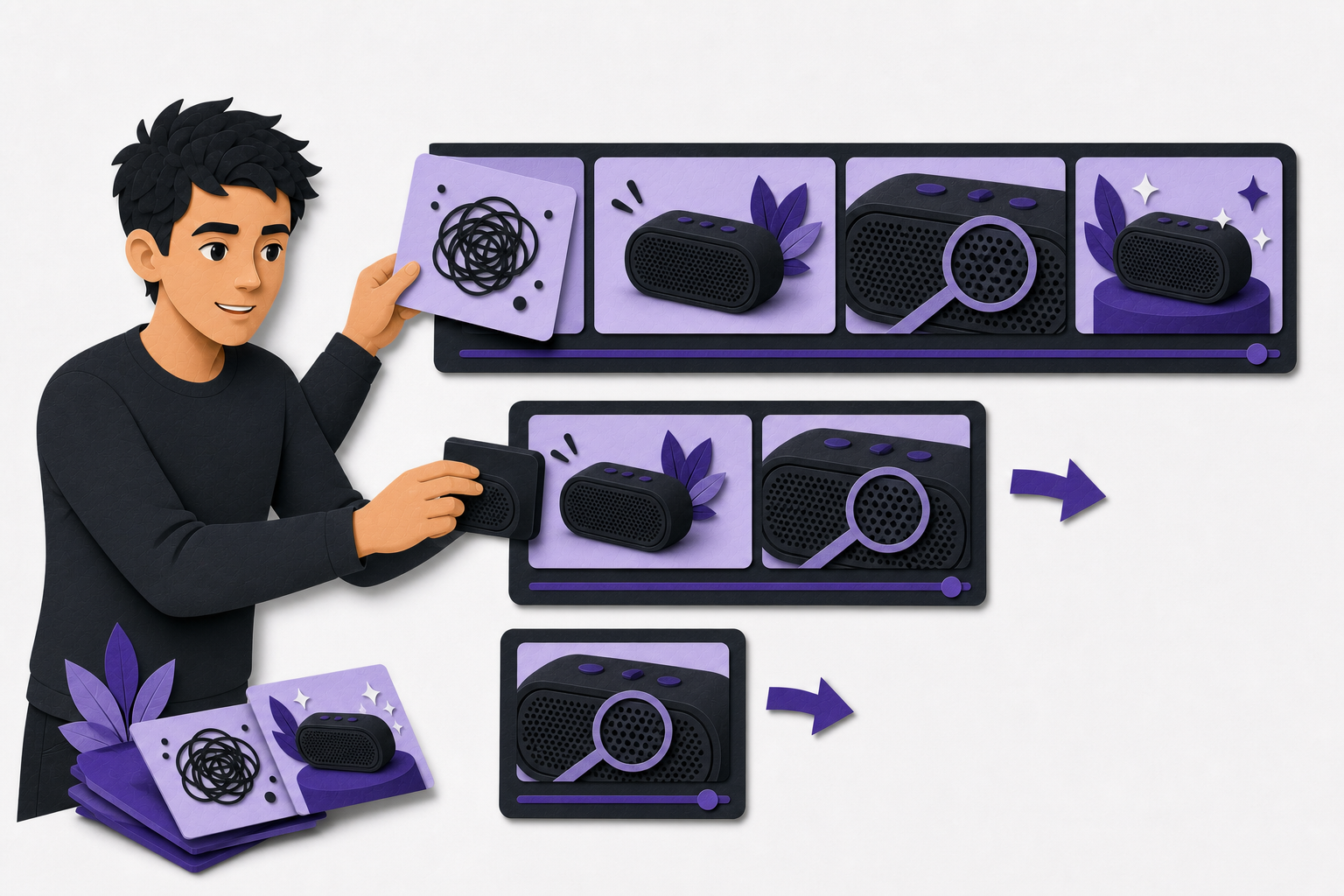
How to compress a 30-second script
- Write the 30-second version first. Clarify the problem, mechanism, proof, and action.
- Build the 15-second version by removing context. Keep the strongest hook, one demonstration, one proof point, and the brand.
- Build the 6-second version by choosing one memory. Show one before-and-after moment or one unmistakable product action.
- Keep branding present, not pasted on. Product shape, color, interface, packaging, and spoken name can all create attribution before the final frame.
One product, three ad lengths
Imagine wireless earbuds with adaptive noise control. The 30-second version follows a young commuter from a noisy street to a focused work session, demonstrates the control modes, adds a battery-life proof point, and closes with the offer.
The 15-second version opens on the noise, shows one tap producing instant calm, adds the battery proof, and presents the brand. The 6-second version shows the noisy-to-calm transformation, the earbuds, and one concise promise. The product stays the same; the communication job changes.
Test the decision, not only the edit
Do not compare durations using unrelated concepts. Start with one strategic idea, produce all three versions, and keep the audience, offer, placement, and measurement window consistent. Evaluate completion rate alongside brand recall, qualified clicks, and conversions. A short ad that finishes often but leaves no memory is not automatically the winner.
Research referenced
This guide draws on peer-reviewed research about mobile video advertising length and consumer response, and research comparing 15- and 30-second online video ads.